
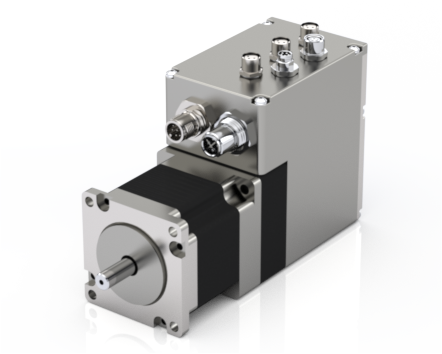
ECOMPACT 23E31, decentralized NEMA 23 servo drive
Technical specifications
| Flange | 56.4 mm |
| Max. DC link voltage | 60 VDC |
| Maximum speed | 2000 rpm |
| Peak torque | 2.15 Nm |
| Stall torque | 1.2 Nm |
Compact servo drive - Motor and servo amplifier in one
Overview
The ECOMPACT 23E31 is a decentralized compact servo drive that combines motor, encoder and servo amplifier in a single NEMA 23 unit. It is part of the ECOMPACT 23E family and is designed for a DC supply from 24 to 60 V, delivering up to 2.15 Nm peak torque and 1.20 Nm stall torque at speeds up to 2000 rpm. This makes it the mid range performance variant within the series, with a strong torque to size ratio for dynamic industrial axes.
With a flange of 56.4 mm, a device length of 164.5 mm and a standard 8 mm shaft, the 23E31 fits into common NEMA 23 based mechanics while providing true servo dynamics instead of simple stepper behavior. The drive uses conduction via the motor flange and natural convection for cooling and is specified with insulation class B and IP40 protection for standard industrial environments.
Mounted directly on the machine, the ECOMPACT 23E31 reduces the space required in the control cabinet and shortens motor cable runs. Depending on configuration, it is available with incremental or absolute encoders, holding brake and gear options, so machine builders can match feedback, holding torque and transmission to the application without changing the basic footprint.
Advantages
- Reduces cabinet space and wiring effort by moving the servo amplifier to the motor and using short local cabling instead of long shielded motor leads, which lowers thermal load and simplifies routing.
- Improves torque to size ratio with up to 2.15 Nm peak torque in a NEMA 23 housing, so designers can achieve higher dynamics without moving to a larger frame size.
- Supports modular, plug and play machine design because each axis becomes a self contained motion node that can be built, tested and reused as a standard module.
- On drive intelligence cuts component count through local current, speed and position control, graphical sequence programming and digital I/O, so some low level PLC tasks can move into the drive.
- Faster commissioning and optimization using ECOSTUDIO, with an integrated oscilloscope, parameter wizards and a verified motor database that help avoid configuration errors and speed up tuning.
Where it fits
- Pick and place and handling modules that need compact, dynamic axes with minimal wiring and clear separation into machine modules.
- Focusing, dispensing, inspection and marking systems where precise positioning in tight spaces benefits from decentralized drives in the 24 to 60 VDC class.
- Lab automation, electronics and optics equipment that typically uses NEMA 23 mechanics but requires better dynamics and smoother motion than integrated stepper solutions can offer.
- Standard industrial environments with IP40 requirements where cabinet capacity is limited and there is value in moving drive electronics close to the mechanics while keeping the power supply central.
Interfaces
- Control modes for digital current, speed and position control with configurable limits for torque, speed and position, so motion behavior can be tailored to the load and mechanics.
- Fieldbus connectivity with full DS402 drive profile support via CANopen and EtherCAT, allowing real time integration into common PLC platforms and multi axis systems.
- Local digital I/O with 5 digital inputs and 2 digital outputs, including insulated channels that help separate signal grounds and reduce the risk of ground loops in larger machines.
- Signal quality and longevity features such as digital filters for vibration management and parameterizable jerk filters that smooth motion transitions and reduce mechanical wear.
- Commissioning and monitoring via ECOSTUDIO with an extensive oscilloscope function, graphical sequence programming and active monitoring of short circuits, voltage levels, temperature and i²t, which supports reliable operation and efficient diagnostics over the life of the axis.